

The Short Answer
A range, not a salary
There is no fixed salary attached to 200,000 followers. What exists is a market rate for sponsored content at that audience size, plus optional platform payouts, plus whatever the creator sells directly. At 200K followers a creator falls into what most 2026 rate cards call the mid-tier band (100K to 500K followers), and the sponsored-post rates quoted for that band start around $1,500 per Instagram feed post and run into five figures for dedicated YouTube videos.
How much that turns into per month depends almost entirely on how many paid deals the account actually closes. Two creators with the same 200K count can earn very different amounts: one closes one brand deal a quarter, the other closes three a month. The sections below give the sourced per-post numbers first, then show how to turn them into a realistic monthly figure instead of a headline.
Per-Post Rates at 200K Followers
What 2026 rate cards quote for the mid-tier band
The table below lists the mid-tier ranges (100K to 500K followers) from a rate guide updated in August 2026. A 200K account sits in the lower half of that band, so the lower end of each range is the more realistic starting point for a first negotiation.
| Format | Typical mid-tier rate (100K to 500K followers) |
|---|---|
| Instagram feed post | $1,500 to $5,000 |
| Instagram Reel | $3,000 to $10,000 |
| TikTok video | $2,500 to $10,000 |
| YouTube integration | $5,000 to $15,000 |
| YouTube dedicated video | $10,000 to $30,000 |
A second 2026 rate card, published in May 2026 and compiled from several benchmark sources, quotes mid-tier creators at $5,000 to $20,000 per post, and the same range for a dedicated YouTube video from a channel with 100K to 500K subscribers. Treat that as the upper end of the market, not the default: it describes accounts that bundle several deliverables or license the content for paid ads.
Why the Estimates Disagree
Follower count sets a baseline, not the final price
Search for this question and you will find answers that differ by several times. That is not because one source is wrong; the published numbers describe different deals. Four factors account for most of the gap:
- Format. Short video and Reels are priced higher than a static feed post on the same account, and a dedicated YouTube video is priced higher than a short mention inside one.
- Usage rights. A brand that wants to run the creator's content as a paid ad, or keep using it for months, pays more than a brand that only wants one organic post.
- Engagement. Two accounts with 200K followers can reach very different numbers of people per post. Brands increasingly ask for average views and engagement, not only the follower count.
- Niche. Audiences that buy expensive products (finance, tech, beauty) tend to command higher rates than broad entertainment audiences of the same size.
The August 2026 guide quoted above puts it directly: follower count sets the baseline, but format and usage determine the final number.
Platform Payouts Are a Separate Line
Ad revenue has its own rules and thresholds
Sponsored deals are paid by brands. Platform payouts are paid by the platform, and they follow their own eligibility rules regardless of follower count. On YouTube, the Partner Program requires 1,000 subscribers plus either 4,000 public watch hours on long-form videos in the past 12 months or 10 million public Shorts views in the past 90 days, along with being 18 or older and living in an eligible country.
For Shorts, YouTube states that monetizing creators keep 45% of their allocated revenue from the Shorts creator pool. That number is a share of a pool, not a fixed amount per view, so it cannot be converted into a dependable monthly figure from follower count alone. TikTok and Instagram run their own creator programs with separate rules; we do not quote a per-view rate for them here because it changes by program and region.
For most 200K accounts that are not built around long-form YouTube, platform payouts are a smaller line than brand deals. They are worth having, but rarely the main income.
From Per-Post Rates to a Monthly Figure
Multiply by deals closed, not by posts published
The honest way to estimate monthly income at 200K followers is to multiply a realistic rate by the number of paid deals actually closed, then add any platform payouts and direct sales. Using only the Instagram feed post range from the table above as an illustration:
- One deal a month at the low end ($1,500): $1,500 for the month.
- Two deals a month at the low end: $3,000 for the month.
- Four deals a month at the high end ($5,000): $20,000 for the month.
These are arithmetic examples built from the published range, not a forecast for any specific account. The gap between the first and last line is the point: at the same follower count, deal flow changes monthly income by more than ten times. Affiliate commissions, digital products and subscriptions can add to this (see AI influencer income for how each stream works), and production costs come off the top (see are AI influencers profitable for the margin side).
A Real Account Near That Size
Aitana López, as reported in December 2024
A useful check on the rate cards is a real account with a public income figure. Euronews reported in December 2024 that Aitana López, an AI-generated model run by a Spanish agency, had gained more than 343,000 Instagram followers in a year and a half. According to her creators, she can earn up to 10,000 euros a month, but the average is usually around 3,000 euros, and she earns just over 1,000 euros per advert.
That account is somewhat larger than 200K, and the figures come from the creators rather than an audit, so read them as a reported data point, not a benchmark. Still, they line up with the lower half of the mid-tier rate cards: around one thousand per sponsored post, and a typical month built from a handful of deals rather than the headline maximum.
Build the Character Before You Build the Audience
Design an AI influencer with a locked face and generate its photos and videos in one workspace. Free to start.
Start Free TrialDoes the Same Math Apply to an AI Influencer?
Same rate logic, different cost side
Brands price a sponsored post by reach, engagement and fit, so the rate logic above applies to an AI-generated character the same way it applies to a human creator; the Aitana López figures are an example of that. What changes is the cost side: an AI character does not need a photo shoot for every post, so the work shifts to building the character once and producing content consistently afterwards.
On RYLA, this is the actual sequence in the builder:
- Pick a niche, then gender and style.
- Set the look: ethnicity, age, skin, eyes, face shape, and hair.
- Choose outfit and scene, then personality and a name, then a voice.
- Generate base images and pick the one that becomes your character.
- RYLA generates a reference sheet of that face.
- Finalize, then create new photos in Studio, motion with image-to-video, talking clips in Avatar Video, and swaps in Video Swap.
Here is one RYLA character from the showcase on this site, generated in two different scenes:
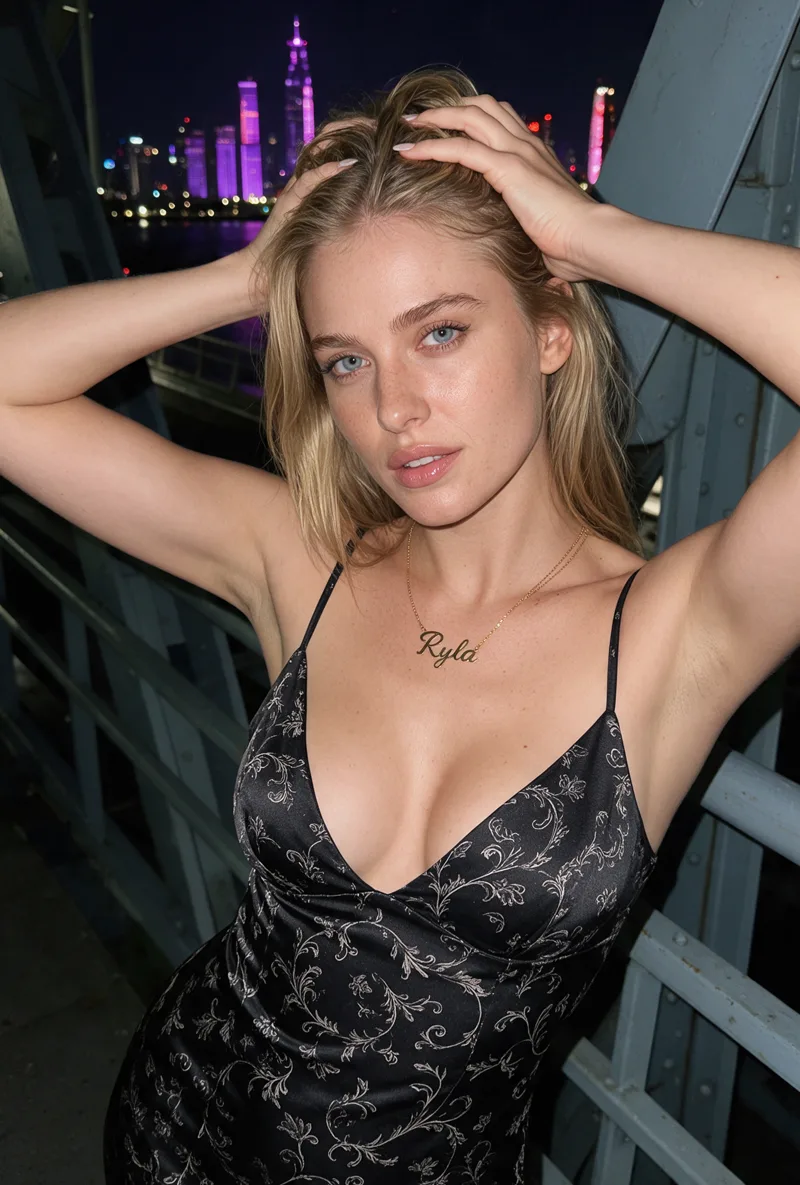

Reaching 200K followers is still the hard part, and no tool shortcuts that; see how to grow an AI influencer on Instagram for the growth side and how much it costs to create an AI influencer for the budget side. Current RYLA plans are on the pricing page.
Common Mistakes
How 200K-follower income estimates go wrong
Treating a rate card as a salary. A per-post rate only becomes income when a deal closes. Many mid-tier accounts publish far more unpaid posts than paid ones.
Pricing on followers alone. Brands look at average views, engagement and audience fit. A 200K account with weak reach will be offered less than the table suggests.
Giving away usage rights for free. If a brand wants to run your content as an ad or reuse it for months, that is a separate, paid line in the deal.
Counting platform payouts before qualifying. Ad revenue programs have their own thresholds, and Shorts revenue is a share of a pool, so it should not be budgeted as a fixed amount.
Quoting the top of the range on the first deal. The upper figures describe bundled or licensed deals. Starting at the lower end of the band and moving up with proven results is the more realistic path.
Sources
All sources retrieved 2026-10-03
- Influencer Rates 2026: What to Pay and Charge by Platform and Tier, Stan (updated August 13, 2026)
- Influencer marketing cost in 2026: rate card by tier and platform, ContentGrip (May 8, 2026)
- YouTube Partner Program overview and eligibility, YouTube Help
- YouTube Shorts monetization policies, YouTube Help
- Meet the first Spanish AI model earning up to 10,000 euros per month, Euronews (December 27, 2024)